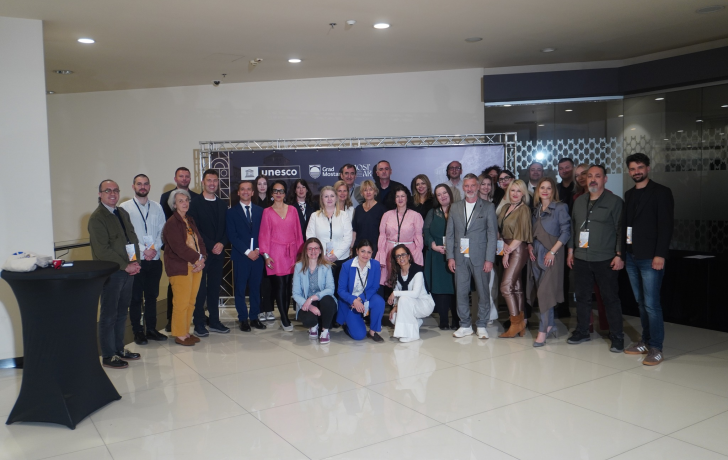
Between April and May 2026, the World Heritage Porticoes Office took part in two major European forums, which reviewed governance policies combining territorial protection, innovation, and creativity.
In Mostar, World Heritage and Creative Cities Converge
On April 27 and 28, 2026, the city of Mostar (Bosnia and Herzegovina) hosted the international conference "UNESCO Creative Cities and World Heritage: Towards Integrated Strategies for Sustainable Cultural Tourism Management". Sponsored by UNESCO as part of the "Culture and Creativity for the Western Balkans" programme (funded by the European Union and jointly implemented by the British Council and the Italian Agency for Development Cooperation), the event marked the first direct collaboration between World Heritage site representatives and the UNESCO Creative Cities Network. Bologna was invited by virtue of its dual recognition, having also been a Creative City of Music since 2006.
The sessions focused on the need to transform UNESCO designations into active urban planning tools capable of balancing economic development with residents' quality of life. Of particular interest for contemporary management models was the session dedicated to technological solutions and funding models. Here, delegates from the city of Bradford (UK), the Republic of Moldova, and major sites such as Istanbul, Berat, and Gjirokastra joined Bologna in discussing the application of digital tools and artificial intelligence to enhance heritage and build new public-private partnerships.
From Mostar to Pula: Scientific Research at the Service of Sustainable Tourism
The journey of international cooperation and strategic protection continued from May 11 to 15, 2026, in Pula, Croatia, at the conference of the UNESCO-UNITWIN academic network "Culture, Tourism, Development", hosted by the "Dr. Mijo Mirković" Faculty of Economics and Tourism. Marking the 25th anniversary of the network led by Professor Maria Gravari-Barbas (Université Paris 1 Panthéon-Sorbonne), the event brought together experts, professors, and researchers from 40 global universities to reflect on the scientific enhancement of cultural heritage. Bologna was invited to share its recent nomination process for inscription on the World Heritage List.
The conference also represented a crucial milestone for the Istrian city itself: in his opening address, Mayor Peđa Grbin highlighted the strategic value of the initiative in Pula’s own bid for the UNESCO World Heritage List, drawing on a unique historical stratification spanning from the Roman era to contemporary times.
International Cooperation as a Pillar for the Porticoes
Both UNESCO network events highlight a key, universal concept: heritage protection cannot exist without strong international cooperation, whether institutional or scientific-academic. The best practices emerging from the exchange between diverse Adriatic, Balkan, and European historical contexts (including, alongside Bologna, Ljubljana, Trogir, and Kotor) offer an essential overview of global conservation trends. For complex, living urban environments like the Porticoes of Bologna, staying connected to these scientific and technological advancements is the key tool to ensuring tourism excellence and long-term sustainability.